This is the second of my team evaluations for the Northwest division. I'm going to be taking a look at the budget for each team for both the upcoming season and the 2010-2011 season as well as looking at each of their significant moves over the last month. In terms of budget expectations, I will use the following as a basic guideline using 56.8M as the cap figure for this season and 50.0M as the possible cap figure for 2010-2011 to see how flexible teams are if the cap declines:
Top 3 Forwards - 27.5%
Middle 6 Forwards - 20.0%
Top 4 Defenders - 27.5%
Goaltending - 10.0%
Bottom 8 players - 15.0%
Many of the statistics used for evaluation wouldn't be possible without the wonderful resources available at nhlnumbers.com, Behind the Net and Time on Ice (thanks Vic and Gabe). I have already taken a look at the Minnesota Wild. Next up is the Colorado Avalanche:
Budget 2009-2010 (56.8M Cap)
Top 3 Forwards - Stastny, Hejduk, Wolski = 13.70 or 24.1%
Middle 6 Forwards - Svatos, ???, ???, ???, ???, ??? = 4.30 or 7.6%
Top 4 Defenders - Hannan, Liles, Salei, Foote = 14.73 or 25.9%
Goaltending - Anderson, Budaj = 3.06 or 5.4%
Bottom 8 Players - Preissing, Quincey, Clark, Koci, Stewart, Hensick, Tucker, McLeod = 12.33 or 21.7%
This team is a bit of a mess and I'm going to assume that they're in full-on re-building mode. The Avalanche are spending way too much money on the bottom of the roster. Most of this is on defense with six different defenders making at least 2.75M. To make matters worse, not one of those six defenders look likely to outperform their contract. Ug. Ly. As far as the forwards go, there really isn't any depth at all. One guy signed and no RFA's to come. Yikes. Then you have the top three guys. They're not terrible by any means but neither do they match up well against the top guys on the other clubs. Now, the Avalanche have enough space that they could try to turn this around but I would instead expect them to tank and go for another high draft pick. At this point, they would be wise to consider playing closer to the floor than to the cap both to save money and to ensure that they stay bad. If they don't find some depth at forward, their task should be easily completed.
1. Colorado drafts Matt Duchene 3rd overall in the 2009 entry draft. Now, before I start, this was a good smart pick by the Avalanche. However, the Avalanche are rebuilding right now. The team this year is destined to suck. In fact, as much as I hate that teams do this, they probably even want to suck. As such, it would make no sense for the Avalanche to let Duchene make the team this year. If he does make the team, he's granted UFA status at 25 instead of 27, he's not going to be as good of a player during his entry level deal and his entry level deal will be wasted on years that the Avalanche want to lose. They haven't decided to put him in the NHL yet but given their lack of forward depth, it would seem to be a very real possibility. It would be the wrong decision.
2. Colorado does not give a qualifying offer to Cody McCormick. This is pretty harsh. A bad team with no forward depth won't give a qualifying offer of less than $600,000. Now, McCormick is pretty bad. He gets outshot and outscored at even strength and doesn't provide much offense while being ranked third last in quality of competition among Avalanche forwards and first in quality of teammates. This guy sucks. Normally I don't like giving away free depth, but really, McCormick probably isn't a replacement level player.
3. Colorado signs Peter Budaj to a one year deal at 1.25M per year. This contract may be Budaj's last with the Avalanche since he'll become an unrestricted free agent next season. They've invested a lot in him to this point so it doesn't surprise me that they wanted to take another look next season. In this list (credit to Derek Zona) of goalies with at least one season since the lockout Budaj ranks 36th in save percentage out of 52 goaltenders with a save percentage .902 since the lockout. The majority of goalies ranked below him are no longer in the NHL. If I were the Avalanche I'd probably have given up on Budaj by now and tried some of the other available goalies, but given the amount of time the Avalanche have put into Budaj, it's understandable they'd try him out for one more year... especially since they aren't really interested in winning games.
4. Colorado signs Craig Anderson to a two year deal at 1.81M per year. According to the same list I referenced above, Anderson ranks 24th among goalies since the lockout in save percentage (.908). The highest ranking UFA goalie was Ty Conklin who ranks 8th with a save percentage of .916. Now save percentage isn't the be-all end-all of goaltending statistics, but it is a good indicator of performance. While I may have preferred Conklin, giving Anderson a shot in split duty on a short term deal is basically the same idea. If Anderson pans out, there's a good chance that he can be signed to a second contract at a pretty affordable rate which gives the Avalanche more money to spend in other areas. For more information on Anderson, you can check out this article by the Contrarian Goaltender.
5. Philadelphia signs Ian Laperriere to a three year deal at 1.17M per year. My understanding is that Laperriere was a very popular player in Colorado. That, along with Colorado's desperate need of middle 6 forwards makes his departure seem a little strange from a Colorado perspective. He's the kind of character guy that can really help a rebuilding team and I would have expected the Avalanche to retain him. Unless Laperriere expressly wanted out of Colorado for a better chance at winning, letting him walk really doesn't make sense.
6. Colorado signs David Koci to a one year deal at 0.58M per year. I really don't think that enforcers have much value. Both Mirtle and Kent have discussed how useless enforcers are at actually playing hockey and I certainly fall in with them. As such, I think this signing is a waste especially since it's one less roster spot available for taking a chance on a real player. Plus, it implies that the management sees a need to have an enforcer on the roster, something that will not serve them well when the team is actually good.
7. Colorado trades Ryan Smyth to Los Angeles for Tom Preissing + Kyle Quincey + 5th round pick. Unfortunately for Avalanche fans, this is actually a decent trade for the Avalanche. The main benefits are clearing out some cap space and moving the rebuilding process forward with the acquisition of Kyle Quincey. The biggest thing here is the money which makes the acquisition of Tom Preissing particularly unpalatable - he has another two years left on his contract and the Avalanche really had no need of another well-paid veteran defenceman.
Quincey is an interesting acquisition. Earlier this year the Kings took him off of waivers from the Red Wings (who in hindsight probably wished they would've waived Brad Stuart's 3.5M deal). Quincey played as a #4 or 5 defenceman for the most part with the Kings. He had the most favourable split of offensive to defensive zone faceoffs on the team and yet was still outscored 5 on 5 (although his Corsi was very good). His power play numbers, on the other hand, were outstanding. He played 3:19 per game and put up 6.28 pts/60 which is an elite number for a defenceman (it beats Pronger, Niedermayer, Lidstrom, Boyle and Green). The Avalanche may really have something good for their power play. If they don't realize it, Quincey could quickly get buried in the rotation.
I always wonder how a fifth round pick gets negotiated into these deals but it's always nice to get another lottery ticket. Overall, I was somewhat underwhelmed with the return given what the Rangers were able to get for Scott Gomez only a few days earlier in another clear salary dump. Still, the important thing is that the Avalanche moved Smyth's contract when they had the chance.
8. Colorado signs David Jones to a two year deal at 0.84M per year, Brian Willsie to a one year deal at 0.6M and Darren Haydar to a one year deal at 0.53M. These are all relatively minor moves that I decided to group together. Although I haven't included any of these players on the above chart, there is a very good chance that all of them spend the year with the Avalanche if more forward help isn't brought it.
David Jones is coming off of his entry level deal with the Avalanche. He split time between the AHL and NHL for the last two years. This past season Jones faced middling opposition with poor teammates and started in the offensive zone 18 more times than the defensive zone. He was both outshot and outscored at even strength and didn't play much of a role on special teams. He really can't be slotted any higher than a fourth lline role at this point.
Brian Willsie is a veteran of close to 400 NHL games. Last season Willsie split time with Colorado and Lake Erie. He played in 42 games with the Avalanche, registering 4 points (0.58 pts/60). He faced the second easiest competition among Avalanche forwards with at least 40 games and was handily outshot and outscored. At best, Willsie is roster filler at the NHL level. In the AHL, he is able to score close to a point per game, so if he spends most of the year in Lake Erie, he might get to help a team win games.
Darren Haydar is the most interesting of the three and in some ways reminds me of Rich Peverley, another relatively small player who scores very well in the AHL. Peverley was claimed by Atlanta off waivers, put with Kovalchuk and had quite a lot of success. Haydar is both smaller than Peverley and a better scorer in the AHL (he led the league last year). Unfortunately for him, there probably isn't a plan to play him with Paul Stastny. That said, this is exactly the kind of player that rebuilding teams need to be giving chances. It's quite possible that Haydar can play in an offensive role in the NHL, and that has value. It's a much better plan than signing then the David Koci's of the world.
If the Avalanche don't make many more acquisitions look for Willsie and Jones to move into the bottom 8 players and for Haydar, Hensick and Tucker to move into the middle 6 forwards. If "lack of forward depth" is part of the game plan, that should cover it.
9. Joe Sakic retires. As an Oiler fan I can't properly understand what this would be like. Sure, Sakic had a great career but he's also been the Avalanche captain since they moved to Colorado. He never asked to be traded, got booed out of town, left as a free agent or cost too much for the owner. All I can really say is that I'm jealous that Colorado got to enjoy Sakic for all these years, both as a player and as a person. For a proper Colorado fan's perspective, you can go to Mile High Hockey. From the team's perspective, Sakic's retirement officially ends an era. For the first time since they moved to Colorado, they suck.
Budget 2010-2011 (50.0M projection)
Top 3 Forwards - Stastny, ???, ??? = 6.60 or 13.2%
Middle 6 Forwards - ???, ???, ???, ???, ???, ??? = 0.00 or 0.0%
Top 4 Defenders - Hannan, Liles, ???, ??? = 8.70 or 17.4%
Goaltending - Anderson, ??? = 1.81 or 3.6%
Bottom 8 Players - Preissing, ???, ???, Jones, McLeod, ???, ???, ??? = 4.38 or 8.8%
The rebuilding process is now well under way. At this point, the Avalanche need to focus on moving some of the remaining players out. They should hold onto Stastny and possibly Liles but one of the main goals of the rest of the summer will be moving Hannan and Preissing out for some future value. This year's trade deadline should will be another opportunity for the Avalanche to turn the players they have now into future value. They're in a good position to begin the turn-around for 2011-2012. Until then, keep moving things for futures and experimenting with guys like Anderson and Haydar and hope to find a gem.
Tuesday, July 7, 2009


The Northwest So Far - Minnesota Wild
Unrestricted free agency has been open for about a week now. I thought that it would be good to take a look at how each team in the Northwest division is doing, both for this coming season and for 2010-11. When I did this exercise before the trade deadline I assumed that most teams would plan for the possibility that the cap could fall to 50M for that 2010-11 season. I still think that this ought to be the strategy going forward. Each team will be evaluated using the following as a general guideline for where money should be expected (modified from my last attempt to better reflect the reality of where most teams are spending money, i.e. more money allocated for goaltending):
Top 3 Forwards - 27.5%
Middle 6 Forwards - 20.0%
Top 4 Defenders - 27.5%
Goaltending - 10.0%
Bottom 8 players - 15.0%
I'll also take a look at each move each team has made in the last month that involves potential NHL players for the upcoming year. Many of the statistics used for evaluation wouldn't be possible without the wonderful resources available at nhlnumbers.com, Behind the Net and Time on Ice (thanks Vic and Gabe). First up is the Minnesota Wild:
Budget 2009-2010 (56.8M Cap)
Top 3 Forwards - Koivu, Bouchard, Havlat = 12.33 or 21.7%
Middle 6 Forwards - Nolan, Brunette, Miettinen, Belanger, Sheppard, Clutterbuck = 11.29 or 19.9%
Top 4 Defenders - Johnsson, Burns, Schultz, Zidlicky = 15.25 or 26.8%
Goaltending - Backstrom, ??? = 6.0 or 10.6%
Bottom 8 Players - Hnidy, Zanon, ???, Weller, Boogaard, Gillies, ???, ??? = 5.27 or 9.3%
The Wild are in very good shape heading into this season budget-wise. They have 3.25M to spend filling out their bottom 8 without overspending on the bottom of the roster. They've overspent slightly in goal but make up for that and more by having a cheap top 3 forwards. If an upgrade presents itself at any position they have enough flexibility to take on some salary.
1. Minnesota trades 2009 4th round pick + 2009 5th round pick to Edmonton for Kyle Brodziak + 2009 6th round pick. I've already looked at this trade quite extensively and I think that this was a solid move by the Wild. Brodziak has filed for arbitration since the trade but his contract should come in at under 1M which is exactly what the team needs for players that are going to be in a fourth line role. The fact that Brodziak has experience with taking a lot of defensive zone draws and killing penalties is a plus. Assuming a deal gets done for 1M or less, the Wild have picked up a very useful player in Brodziak.
2. Minnesota does not give a qualifying offer to Dan Fritsche. Fritsche has not established much success at the NHL level to this point but he has played four NHL seasons. He was taking on middling opposition with middling teammates and breaking even. In addition, Fritsche started in the defensive zone 29 more times than in the offensive zone, so he wasn't really being sheltered. On the other hand his Corsi number bested only Derek Boogaard and Colton Gillies among Wild players that managed at least 40 games and he has already had to deal with a small history of injuries. On balance, I can understand why the Wild decided not to qualify him at just under 1M but I think that I would have done it. Young fourth line players who can move up the lineup in a pinch and play for less than 1M are worth keeping around. The gains in depth made by bringing in Brodziak are probably mostly lost by losing Fritsche for nothing.
3. Minnesota signs Greg Zanon to a three year deal at 1.93M per year. Greg Zanon played last season in Nashville's top four. Although Zanon's Corsi number was quite poor (second worst among regulars and worst among Nashville defencemen), he did have 132 more starts in the defensive zone than the offensive zone. Still, that's an awful lot of ground to make up. Just by eyeballing it, I don't think he made it. Thankfully, JLikens has made it possible for me to do more than eyeball. According to his adjusted zoneshift Zanon was one of the one hundred worst players in the NHL at getting the puck moving in the right direction at even strength.
But that wasn't Zanon's only contribution. He and partner Dan Hamhuis were also the first option on Nashville's penalty kill so I would expect him to be used in that role as well. Unfortunately for the Wild, the Predators penalty kill was scored on far more often with Zanon on the ice (6.57 GA/60) as opposed to on the bench (3.19 GA/60). It's quite possible that part of the reason is Zanon's ice time against the other team's top power play options. Still, that's a lot of ground to make up.
Like Brodziak, Zanon played for the Wild's new coach, Todd Richards, in the AHL so, if nothing else, the coach will have a lot of confidence in what Zanon brings to the table. Still, I'm not a big fan of this signing. He provides pretty much no offence. This past year was, if anything, his best and at 29 it's very likely that he's not still improving. Considering that he's currently going to be #5 for Minnesota, the price tag looks a bit steep but the Wild have enough cheap options that this isn't a big concern for them. Going forward Zanon is insurance for the top 4 and it may be that Minnesota sees him in that role for the last two years of his contract. Overall, I think this is a pretty weak signing.
4. New York signs Marian Gaborik to a five year deal at 7.5M per year. If Gaborik is healthy this deal could work well, but I really don't fault the Wild for not doling out this kind of cash for Gaborik. The money is the most per season of any free agent signed this summer and there were other options available. Letting go of Gaborik made it imperative that the Wild pursue one of those other high-end options.
5. Minnesota signs Martin Havlat to a six year deal at 5M per year. This deal locks Havlat in for his 28 through 33 year old seasons which makes the length of the deal a big win for the Wild. Havlat is a very good player at both ends of the rink. Havlat was third among forwards in terms of quality of competition this past season with the Blackhawks and started 59 more faceoffs in the offensive zone than the defensive zone. He was by no means sheltered, but did receive some offensive time. 2.89 pts/60 and a +22 at even strength. If health was of on concern this deal would be a clear win for the Wild. Even with the injury risk factored in, it looks pretty darn good. This was by far the biggest move for the Wild this summer and they made it a good one.
6. Minnesota signs Shane Hnidy to a one year deal at 0.75M per year. Hnidy was a bottom pairing defender in Boston last season and will probably be a bottom pairing defender in Minnesota. This signing ensures that the Wild have veterans six deep on the blueline. Hnidy is getting a bit older but should still be able to offer capable defence as Minnesota's #6 option. Plus, the price is good. A nice depth signing for the Wild.
Budget 2010-2011 (50.0M projection)
Top 3 Forwards - Koivu, Bouchard, Havlat = 12.33 or 24.7%
Middle 6 Forwards - Brunette, Miettinen, ???, ???, ???, ??? = 4.67 or 9.3%
Top 4 Defenders - Burns, Schultz, Zanon, ??? = 8.98 or 18.0%
Goaltending - Backstrom, ??? = 6.0 or 12.0%
Bottom 8 Players - ???, ???, ???, ???, ???, Gillies, ???, ??? = 1.04 or 2.1%
Every position is on budget even if the cap declines with the exception of Backstrom in goal. Most of the extra that will be required there is already made up for with their cheap top three forwards. If the backup is a bit pricy the Wild are well-positioned to save some money in their top 4 defenders. Given the amount of money they still have to spend on the top 4 defenders, they may even be able to push Zanon down into the bottom pairing. The wonderful contracts given to Schultz, Burns and Koivu have really set this team up nicely. There are no egregious problem contracts on the team at this point. If the cap really does go down, the Wild should be able to pick up some great talent at a fantastic rate next summer.
Top 3 Forwards - 27.5%
Middle 6 Forwards - 20.0%
Top 4 Defenders - 27.5%
Goaltending - 10.0%
Bottom 8 players - 15.0%
I'll also take a look at each move each team has made in the last month that involves potential NHL players for the upcoming year. Many of the statistics used for evaluation wouldn't be possible without the wonderful resources available at nhlnumbers.com, Behind the Net and Time on Ice (thanks Vic and Gabe). First up is the Minnesota Wild:
Budget 2009-2010 (56.8M Cap)
Top 3 Forwards - Koivu, Bouchard, Havlat = 12.33 or 21.7%
Middle 6 Forwards - Nolan, Brunette, Miettinen, Belanger, Sheppard, Clutterbuck = 11.29 or 19.9%
Top 4 Defenders - Johnsson, Burns, Schultz, Zidlicky = 15.25 or 26.8%
Goaltending - Backstrom, ??? = 6.0 or 10.6%
Bottom 8 Players - Hnidy, Zanon, ???, Weller, Boogaard, Gillies, ???, ??? = 5.27 or 9.3%
The Wild are in very good shape heading into this season budget-wise. They have 3.25M to spend filling out their bottom 8 without overspending on the bottom of the roster. They've overspent slightly in goal but make up for that and more by having a cheap top 3 forwards. If an upgrade presents itself at any position they have enough flexibility to take on some salary.
1. Minnesota trades 2009 4th round pick + 2009 5th round pick to Edmonton for Kyle Brodziak + 2009 6th round pick. I've already looked at this trade quite extensively and I think that this was a solid move by the Wild. Brodziak has filed for arbitration since the trade but his contract should come in at under 1M which is exactly what the team needs for players that are going to be in a fourth line role. The fact that Brodziak has experience with taking a lot of defensive zone draws and killing penalties is a plus. Assuming a deal gets done for 1M or less, the Wild have picked up a very useful player in Brodziak.
2. Minnesota does not give a qualifying offer to Dan Fritsche. Fritsche has not established much success at the NHL level to this point but he has played four NHL seasons. He was taking on middling opposition with middling teammates and breaking even. In addition, Fritsche started in the defensive zone 29 more times than in the offensive zone, so he wasn't really being sheltered. On the other hand his Corsi number bested only Derek Boogaard and Colton Gillies among Wild players that managed at least 40 games and he has already had to deal with a small history of injuries. On balance, I can understand why the Wild decided not to qualify him at just under 1M but I think that I would have done it. Young fourth line players who can move up the lineup in a pinch and play for less than 1M are worth keeping around. The gains in depth made by bringing in Brodziak are probably mostly lost by losing Fritsche for nothing.
3. Minnesota signs Greg Zanon to a three year deal at 1.93M per year. Greg Zanon played last season in Nashville's top four. Although Zanon's Corsi number was quite poor (second worst among regulars and worst among Nashville defencemen), he did have 132 more starts in the defensive zone than the offensive zone. Still, that's an awful lot of ground to make up. Just by eyeballing it, I don't think he made it. Thankfully, JLikens has made it possible for me to do more than eyeball. According to his adjusted zoneshift Zanon was one of the one hundred worst players in the NHL at getting the puck moving in the right direction at even strength.
But that wasn't Zanon's only contribution. He and partner Dan Hamhuis were also the first option on Nashville's penalty kill so I would expect him to be used in that role as well. Unfortunately for the Wild, the Predators penalty kill was scored on far more often with Zanon on the ice (6.57 GA/60) as opposed to on the bench (3.19 GA/60). It's quite possible that part of the reason is Zanon's ice time against the other team's top power play options. Still, that's a lot of ground to make up.
Like Brodziak, Zanon played for the Wild's new coach, Todd Richards, in the AHL so, if nothing else, the coach will have a lot of confidence in what Zanon brings to the table. Still, I'm not a big fan of this signing. He provides pretty much no offence. This past year was, if anything, his best and at 29 it's very likely that he's not still improving. Considering that he's currently going to be #5 for Minnesota, the price tag looks a bit steep but the Wild have enough cheap options that this isn't a big concern for them. Going forward Zanon is insurance for the top 4 and it may be that Minnesota sees him in that role for the last two years of his contract. Overall, I think this is a pretty weak signing.
4. New York signs Marian Gaborik to a five year deal at 7.5M per year. If Gaborik is healthy this deal could work well, but I really don't fault the Wild for not doling out this kind of cash for Gaborik. The money is the most per season of any free agent signed this summer and there were other options available. Letting go of Gaborik made it imperative that the Wild pursue one of those other high-end options.
5. Minnesota signs Martin Havlat to a six year deal at 5M per year. This deal locks Havlat in for his 28 through 33 year old seasons which makes the length of the deal a big win for the Wild. Havlat is a very good player at both ends of the rink. Havlat was third among forwards in terms of quality of competition this past season with the Blackhawks and started 59 more faceoffs in the offensive zone than the defensive zone. He was by no means sheltered, but did receive some offensive time. 2.89 pts/60 and a +22 at even strength. If health was of on concern this deal would be a clear win for the Wild. Even with the injury risk factored in, it looks pretty darn good. This was by far the biggest move for the Wild this summer and they made it a good one.
6. Minnesota signs Shane Hnidy to a one year deal at 0.75M per year. Hnidy was a bottom pairing defender in Boston last season and will probably be a bottom pairing defender in Minnesota. This signing ensures that the Wild have veterans six deep on the blueline. Hnidy is getting a bit older but should still be able to offer capable defence as Minnesota's #6 option. Plus, the price is good. A nice depth signing for the Wild.
Budget 2010-2011 (50.0M projection)
Top 3 Forwards - Koivu, Bouchard, Havlat = 12.33 or 24.7%
Middle 6 Forwards - Brunette, Miettinen, ???, ???, ???, ??? = 4.67 or 9.3%
Top 4 Defenders - Burns, Schultz, Zanon, ??? = 8.98 or 18.0%
Goaltending - Backstrom, ??? = 6.0 or 12.0%
Bottom 8 Players - ???, ???, ???, ???, ???, Gillies, ???, ??? = 1.04 or 2.1%
Every position is on budget even if the cap declines with the exception of Backstrom in goal. Most of the extra that will be required there is already made up for with their cheap top three forwards. If the backup is a bit pricy the Wild are well-positioned to save some money in their top 4 defenders. Given the amount of money they still have to spend on the top 4 defenders, they may even be able to push Zanon down into the bottom pairing. The wonderful contracts given to Schultz, Burns and Koivu have really set this team up nicely. There are no egregious problem contracts on the team at this point. If the cap really does go down, the Wild should be able to pick up some great talent at a fantastic rate next summer.
Monday, July 6, 2009
Predicting Points
Whenever fans and teams look at signing potential unrestricted free agents to fill an important offensive role, the offensive track record of the player in question is obviously a major factor. The main statistic used in determining offensive success is points, i.e. a vital contribution to a goal scored either by shooting or passing the puck. I decided to take a brief look at the repeatability of points at the NHL level. To do this I looked at players who played in at least 50 NHL games in their 25, 26, 27, 28 and 29 year-old seasons and who were still playing in the NHL last season. I took an average of the first four seasons in terms of points per game (so seasons of 0.4, 0.45, 0.55 and 0.6 would average out to 0.5 regardless of the number of games played in each season so long as each season had at least 50 games played) and disqualified any player that averaged less than 0.5 points per game over the four year period. This left me with only 24 players (the lockout caused many players to lose one of these seasons). I then used the average of the first four seasons as a prediction for the performance of the player in his 29 year-old season. These are the results:
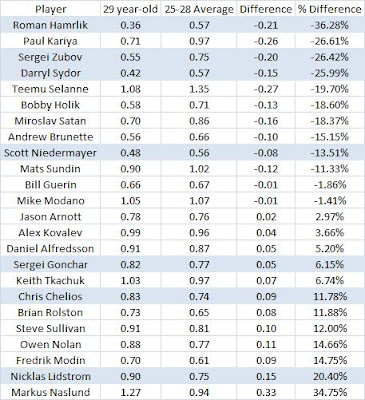

Admittedly, we're looking at a very small sample of players here. Still, the results look pretty close to what I would have expected: 75% of the time the player performs within 20% of his established ability over the previous four-year period. For the forwards the player performs within 20% of his established ability over 85% of the time. Obviously a larger sample of players will be needed in order to test these results. Fortunately, we are now entering the fifth year since the lockout. As such, I can predict the point totals for players entering their 29 year-old season this year using the previous four years as a base. If nothing else, this will be a fun experiment to revisit (triumphantly!) in nine months. Here are the predictions for the forwards who meet all of the criteria (have played at least 40 NHL games in each of the last four years, are entering their 29 year-old season and have achieved an average of 0.50 point per game over the previous four seasons). I included the cap hit as well as a high and low estimate, in terms of points per game, for next season.
A few notes for Oiler fans... Dany Heatley looks like a pretty good bet. As much as the situation with Heatley has been frustrating, there really aren't many players that have his offence and durability. I can see why the team is pursuing him to the point of embarassing themselves. If Heatley doesn't work, Jonathan Cheechoo might not be a bad idea. Granted, his last two years haven't been anything special, but that's part of why he's available. A bounce-back year from him could make for a big payoff. Finally, a guy like Robert Nilsson probably has some value to a team that thinks he can put up between 40 and 60 points. That's a talent that costs mucho money on the UFA market.
God Bless Kris Versteeg
I've been following the Chicago Blackhawks RFA contract saga over the last couple of days and today was a day of many happenings on that front. The afternoon started off rather well with TSN reporting that the NHLPA did in fact request that the players should be considered unrestricted free agents. Now, that doesn't mean that the players involved were granted UFA status. In fact, it seems overwhelmingly likely that the decision would be left with an independent arbitrator. Later this afternoon, however, the Blackhawks almost made it a moot point by signing all of the players who did not receive proper qualifying offers. All of them, except for Kris Versteeg (incidently, Mr. Tallon, these are not the actions of someone who "doesn't expect any significant fallout").
I had thought that if there would be one player holding on for dear life that it would surely be Aaron Johnson given his agent's earlier comments. In hindsight Versteeg probably makes the most sense as he (and Cam Barker who signed a three year deal with the Blackhawks) has the most to gain by becoming an unrestricted free agent. In some ways, Dale Tallon is now in a very difficult situation. It's unlikely that he'll be able to sign Versteeg and keep him on the Blackhawks. At the same time, if he doesn't sign him, Versteeg is gone for no return. It's probably in Tallon's best interests to sign Versteeg, even to a bit of an overpay, if he's sure that he can move him to someone else for something of value. Versteeg too has some incentive to sign now. Howie Mandel's offers are now probably much higher than what they will be if Versteeg loses in arbitration. If he is offered 3M now, expects 4M if he wins in arbitration and gains UFA status but only 2M if he loses, it may be worth it to just sign with the Hawks. This, I assume, was Cam Barker's reasoning. As for me, I can only hope that Versteeg can hold on until the hearing is over. Without him, we may never know for sure that the Blackhawks would be duly punished for their utterly ridiculous mismanagement and, well, I'd like to know. Then again, I'm not the one risking hundreds of thousands of dollars. (Go for the big money!)
I had thought that if there would be one player holding on for dear life that it would surely be Aaron Johnson given his agent's earlier comments. In hindsight Versteeg probably makes the most sense as he (and Cam Barker who signed a three year deal with the Blackhawks) has the most to gain by becoming an unrestricted free agent. In some ways, Dale Tallon is now in a very difficult situation. It's unlikely that he'll be able to sign Versteeg and keep him on the Blackhawks. At the same time, if he doesn't sign him, Versteeg is gone for no return. It's probably in Tallon's best interests to sign Versteeg, even to a bit of an overpay, if he's sure that he can move him to someone else for something of value. Versteeg too has some incentive to sign now. Howie Mandel's offers are now probably much higher than what they will be if Versteeg loses in arbitration. If he is offered 3M now, expects 4M if he wins in arbitration and gains UFA status but only 2M if he loses, it may be worth it to just sign with the Hawks. This, I assume, was Cam Barker's reasoning. As for me, I can only hope that Versteeg can hold on until the hearing is over. Without him, we may never know for sure that the Blackhawks would be duly punished for their utterly ridiculous mismanagement and, well, I'd like to know. Then again, I'm not the one risking hundreds of thousands of dollars. (Go for the big money!)
Sunday, July 5, 2009
Aaron Johnson Files For Arbitration
The deadline for player-elected salary arbitration has come and gone with twenty players electing arbitration with their teams (the deadline for team-elected salary arbitration is tomorrow). Of these twenty I thought that Aaron Johnson was the most interesting of the players who decided to file. As of now there is an on-going investigation as to whether or not Johnson is in fact a restricted free agent thanks to some very poor planning on the part of Chicago's management. Furthermore, it was Johnson's agent, Allan Walsh, that publicly commented on Chicago's improper tendering of qualifying offers. I don't know what effect Johnson's decision to file for arbitration might have on the investigation but it seems that he and his agent expect him to remain a restricted free agent. It will be interesting to see what happens if the situation with Chicago's free agents is not decided by the time Johnson has his arbitration hearing scheduled.
Saturday, July 4, 2009
Martin Havlat Believes in Karma
TSN is reporting that several restricted free agents that play for the Chicago Blackhawks:
Chicago tendered qualifying offers to several key players this week, including Kris Versteeg, Cam Barker, Ben Eager, Colin Fraser, Aaron Johnson and Troy Brouwer however the investigation underway is to determine whether the qualifying offers were filed correctly.
If not, there is the remote possibility the qualifying offers could be ruled invalid and the players listed above, conceivably, could be deemed unrestricted free agents because of the blunder.
(...)
Chicago general manager Dale Tallon says the qualifying offers were mailed to the players in time, on June 29th, but says because of the July 1 holiday, some of the players didn't receive them in time... Tallon says fax copies of the offers were sent to the league, so he doesn't anticipate any significant fall out.
The fact that there is any doubt about whether or not the qualifying offers were filed incorrectly should be reason enough for Tallon to be fired. This is not the kind of thing that is particularly difficult but, if done incorrectly, can cost the team dearly in terms of cash, cap space and talent. Frankly, the Hawks look to be up the creek as well. The CBA seems to be quite clear on this issue (the first paragraph is from 10.2(a) on page 28 and the second is from Exhibit 3 on page 256):
"In order to receive a Right of First Refusal or Draft Choice Compensation (at the prior club's option) with respect to a Restricted Free Agent, the prior club of the Restricted Free Agent must tender to the Player, no later than 5:00 p.m. New York time on the later of June 25 or the first Monday after the Entry Draft of the finaal year of the Player's SPC, a "Qualifying Offer," which shall be an offer of an SPC..."
"From the day after the conclusion of a Player's Playing Season until the commencement of the Player's subsequent Playing Season, notice(s) shall be sent via overnight delivery to the Player's off-season address which the Player provides to the Club... If no method of service is specified in this Agreement, service of the required notice shall be effectuated by either facsimilie transmission or overnight mail delivery by an established nation-wide delivery service."
There are quite a few problems, then, with what Mr. Tallon has done here. Firstly, Tallon sent the qualifying offers on the day that they needed to be received. The due date for qualifying offers this year was in fact June 29th. His excuse that the players did not receive them in time because of the July 1st holiday is therefore completely irrelevant. The fact that there is a holiday two days after the deadline has precisely no bearing on whether or not the qualifying offer has been received by the deadline. If I have a report due on June 29th I cannot claim that the July 1st holiday prevented me from finishing it on time.
Secondly, Tallon, apparently, used regular mail. This is in clear violation of the CBA which states that all correspondance must be sent to the player via overnight delivery. If Tallon had sent the qualifying offers on June 29th via overnight delivery there is no reason for them not to have been received by June 30th (which would still be late, but we've covered that one already). Thus, it seems that Tallon not only sent the offers late, but also by improper means.
Thirdly, Tallon's defense is that he sent faxed copies of the offers were sent to the league... which is completely irrelevant. The CBA requires that the player receives the qualifying offer by the first Monday after the entry draft. If the player does not receive the offer, the team loses their Right of First Refusal and their ability to collect draft pick compensation. The fact that the league received copies of the offers does not matter if the players didn't receive them.
The fact that Tallon is using this as his defense suggests that he is guilty of being in violation of the collective bargaining agreement. If this is so, he should be fired whether or not the players actually become unrestricted free agents. This is simply terrible management. However, the fact that the players did not declare themselves unrestricted free agents on July 1st is curious. It seems that Tallon may have called the players to let them know that offers were coming and the players decided to let it slide. So why is the story coming out now? To be honest I'm not sure. Apparently Allan Walsh tweeted about the qualifying offers not being sent shortly after the story appeared on TSN. If I had a guess, it would be that Allan Walsh is in fact TSN's source and that, at least his client, may want to test the UFA waters but isn't sure how to go about doing it. If the player agreed verbally that he considered himself to have received a qualifying offer he may not be sure of his status.
The situation is similar to one that occured in 2000 when Lou Lamoreillo forgot (dear me...) to send qualifying offers to John Madden and Brian Rafalski (and he resigned both of them). In that case both players became unrestricted free agents. Still, there are important differences. Firstly, there was a different CBA in place in 2000. Secondly, the players were not sent qualifying offers at all. Thirdly, the players knew that they were unrestricted free agents and didn't, as far as I know, give any verbal indication otherwise. I can see why this situation is a bit more nuanced. Offers were sent but they were late. Tallon, it seems, made contact with the players and the players, by virtue of the fact that they did not declare themselves unrestricted free agents, seemed to accept that they had in fact been qualified. It will be interesting to see if any of the players takes this decision to an arbitrator. Tom Benjamin has suggested that the agents will need to strongly defend the rights of their players here since both the NHL and NHLPA would probably rather the players remain restricted free agents. I don't think that's entirely true with respect to the NHLPA. Surely the union has an interest in making sure the clubs comply with the rules of the CBA. The last thing the players need is for teams to begin to get wishy-washy on whether or not they are restricted or unrestricted free agents on July 1st. As such, I would expect the union to strongly back the players right to be unrestricted free agents.
Tuesday, June 30, 2009
Bouwmeester in Calgary
Congratulations to the Calgary Flames on signing Jay Bouwmeester. The cap hit (6.6M/year) is very reasonable and the five-year term leaves the team with options going forward. The fact that they're covered from spending too much if Bouwmeester were injured was probably a feature for ownership. The fact that they're not paying into Bouwmeester's post-prime years has got to be a feature for the team as well. No matter what they move out, the Flames will likely be getting back more than the third round pick they sent away. Given what New York was able to get in return for Scott Gomez, I have no trouble believing that the Flames could move any of Regehr, Iginla, Jokinen or Phaneuf for useful (and potentially very useful) parts. If they manage to move Kiprusoff and replace him with an average or better NHL netminder they could be a very good team this year and going forward. The Edmonton Oilers... traded Kyle Brodziak.
Subscribe to:
Posts (Atom)
